Finding Confidence Again as a Young Stroke Survivor
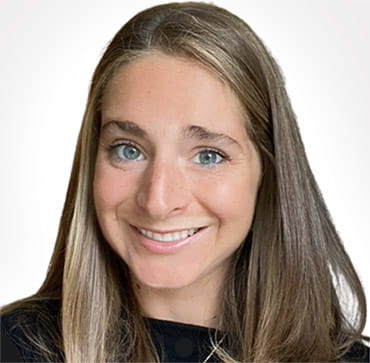 In this column, Hannah Halaska, stroke survivor and Stroke Onwards’ community engagement and content manager, offers a compelling firsthand perspective of rebuilding life after stroke — navigating the challenges of young adulthood, starting fresh as a recent college graduate and finding renewed confidence and purpose after a life-changing event.
During her junior year at the University of Wisconsin–Madison, Hannah Halaska was studying abroad in London. On April 4, 2023, Hannah woke up, went to her first class and realized she could no longer form sentences or find the words she wanted to say.
Hannah had suffered a seizure, a blood clot and a stroke that resulted in lifelong aphasia. Her parents flew from Wisconsin to London, where Hannah received an emergency craniectomy, a type of brain surgery that relieves pressure on the brain. She was in a coma for 17 days.
Immediately after her stroke, Hannah’s speech was very limited. She soon realized that regaining independence would be her greatest challenge, especially as a young stroke survivor with ambitions to complete her degree and graduate. “As a communication major … with my passion for talking with people, I always knew I would go back to school,” Hannah said. “However, my doctors said, ‘Maybe you can take one class in a few years.’ I was devastated. I was supposed to graduate the following year, in 2024.”
Through extensive speech therapy, occupational therapy and work as a restaurant hostess to practice communication skills, Hannah’s speech slowly improved. Working in a restaurant was not always easy. Aphasia is often invisible to strangers, and while Hannah shared her diagnosis with coworkers, customers did not always understand what she was experiencing.
Many customers complimented her hair, unaware that she wore a wig because half of her head had been shaved for surgery. Other customers were less compassionate, with one person asking Hannah, “Are you drunk?” when Hannah struggled with speech.
Despite these struggles, Hannah knew that every day was a new challenge, and her hard work eventually helped her speech improve. Hannah returned to school to pursue her communication degree in fall 2024 and graduated in spring 2025.
Hannah is part of a growing population of young stroke survivors. As reported by the Centers for Disease Control and Prevention, from 2011–2013 to 2020–2022, stroke prevalence increased 14.6% among adults ages 18-44. Young stroke survivors face unique challenges, such as completing their education, finding consistent employment, regaining a robust social circle and rebuilding their identity. Most of their peers cannot relate to struggling with their health or a disability.
 When asked about advice for other young stroke survivors, Hannah said, “I would say that your attitude is extremely important because it’s the only thing you can control. There will be a lot of uncertainty for a long time … Embrace the chaos. Everything is not normal, but if you can recognize this, you can be aware of the changes in your life.”
In the summer after graduating, Hannah applied to multiple communication jobs every day, wrestling with when, where and how to tell interviewers about her aphasia. In a cover letter? During the first interview?
Fortunately, Hannah found a role where her perspective and experience with stroke and aphasia are assets to her work, not obstacles. Hannah now works for Stroke Onward as a community engagement and content manager, helping other survivors share their stroke journeys and build community. She is a valued member of the team, by her co-workers and the community that she supports.
In fall 2025, Hannah took on another challenge: teaching yoga. “Pre-stroke, I always wanted to teach yoga,” Hannah said. “I thought I could never be a yoga [instructor] post-stroke, because of [my] aphasia.” With dedication and practice, Hannah is now able to teach at Puppies & Yoga in Milwaukee.
She knows her journey is just beginning. From her yoga training, Hannah learned, “If you fall, get back up.” With aphasia, her speech can be awkward in professional and personal situations, but Hannah knows that owning her aphasia has helped her to accept her stroke. If she stumbles on a word, she gets back up.
Hannah recognizes that her confidence has been affected by having a stroke, especially at such a formative time in her life. She still struggles at times, but avoiding comparisons with others helps, reminding herself that “Comparison is the thief of joy.” Instead, Hannah thinks about her accomplishments and progress, remembering that she is on her own path.
After recently celebrating the three-year anniversary of her stroke, her “Ha-nniversary,” she reflected, “That mindset helps me feel more comfortable in my own skin.”


