Centering Stroke Survivors to Improve Stroke Care
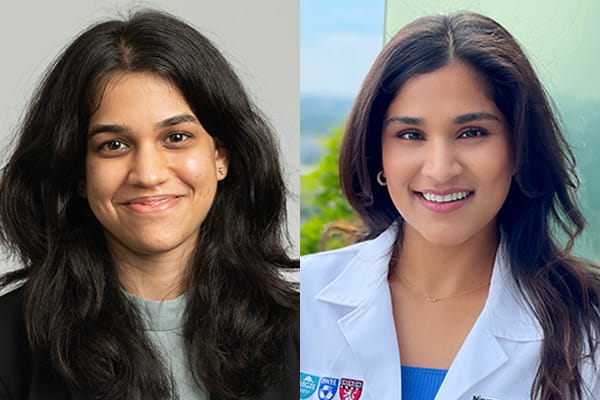
Dr. Devanshi Choksi (left) and Dr. Nirupama Yechoor (right)
Dr. Nirupama Yechoor is the Medical Director of the Neurosciences Intensive Care Unit at Massachusetts General Hospital and an Assistant Professor of Neurology at Mass General Brigham/Harvard Medical School. Dr. Devanshi Choksi is a postdoctoral research fellow at Massachusetts General Hospital. Together, they study how to improve care and recovery for people with neurological illnesses. Their work focuses on both medical care and the social factors that affect health.
Putting Stroke Survivors at the Center of Research
Three years ago, Dr. Yechoor and Dr. Choksi received an American Heart Association Collaborative Sciences Award. Their goal was to place stroke survivors at the center of stroke research. Instead of having researchers decide alone which questions were most important, they wanted to learn directly from people who had lived through stroke recovery.
Listening to Real-Life Experiences
Working with Stroke Onward, the research team recruited stroke survivors and care partners from across the United States. Participants represented different backgrounds, ages and life experiences. Through interviews and focus groups, survivors shared stories about:
- Recovering from stroke
- Returning to work
- Rebuilding relationships
- Caring for family members
- Finding support
These experiences often happen outside the doctor's office, but they have a major impact on recovery.
Understanding the Gaps in Stroke Recovery
As part of this project, Dr. Yechoor and Dr. Choksi published their findings and hosted discussions through the Stroke Onward Community Circle (SOCC). One question guided much of their work: How can research better reflect the real experiences of stroke survivors?
The team found that there is often a gap between what survivors’ experience and what researchers choose to study. While medical treatment is essential, many challenges begin after a person leaves the hospital and returns to daily life.
Their research highlighted several areas that deserve more attention, including:
- Spiritual well-being
- Loss of independence
- Fear about the future
- Feelings of shame and loneliness
- Difficulty understanding health information
The Emotional Challenges of Recovery
Many survivors spoke about the emotional side of recovery and how difficult it can be to adjust to changes in their abilities.
One survivor shared:
“I had a walker and that actually helped me out a lot. Even though I was embarrassed to use it out in public because I was 22.”
Another participant described the emotional impact of living with a disability after stroke:
“We’re using a handicapped tag and people are commenting on how slow I’m walking in the grocery store or asking why I need that tag? There are all these emotional pieces to feeling like I have to justify that in my head.”
These experiences show that recovery involves much more than physical healing.
The Importance of Community and Peer Support
Their 2026 paper highlights the importance of community and peer support.
One participant said:
“But in terms of community, the one thing that stands out most of all is there is a meditation group that gathers outside my place of work. It is very peaceful and allows me to process my emotions. I cannot do this when I’m writing emails at work because usually that’s when I can’t channel my anxiety that well.“
Many participants said that talking with other stroke survivors, both in-person and online, helped them feel understood and gave them hope. The findings suggest that peer support should be viewed as an important part of recovery, not just an optional service. Healthcare systems should find ways to make these programs more widely available alongside rehabilitation.
Making Health Information More Accessible
The research also revealed opportunities to improve how health information and education is presented.
Many hospital discharge packets and educational materials are too long, too complicated, or not helpful during a stressful time.
One clinician observed:
“We have a brochure that I don’t believe is the best method. It’s 40 pages long with chapters. It doesn’t seem like the most effective approach when you’re in crisis.”
The researchers believe that improving health literacy requires more than using simpler words. It means creating information in different formats that meet survivors where they are and help them throughout recovery.
The Ongoing Work
In a recent research abstract, the team identified additional gaps in the care and resources available to stroke survivors. Although these findings are still being reviewed, they support a growing belief that scientific research and lived experiences should work hand in hand.
Stroke survivors can help shape:
- The questions researchers ask
- The programs that are developed
- The policies that guide stroke care
At its core, this work is about partnership. It brings together stroke survivors, care partners, advocacy organizations like the American Heart Association and Stroke Onward, healthcare professionals, therapists and researchers.
Survivor experience should not only be used to validate research after studies are completed. They should help guide the research from the beginning.
By listening to people's experiences, researchers gain valuable knowledge that can improve care, influence policy and lead to better research. Putting stroke survivors at the center of research can help create a stroke care system that is more responsive, more inclusive and better for everyone it serves.


