Know Your Heart Health Numbers
People at risk for heart failure or living with heart failure often have other health conditions that affect how well the heart works. High blood pressure, high cholesterol, diabetes, kidney disease and excess weight can all increase the risk of developing heart failure or cause existing heart failure to progress.
Even if you don’t feel symptoms of heart failure, it's important to track and understand your numbers. Changes in heart function, kidney health, blood sugar or blood pressure may happen before you feel different. Knowing your numbers can help you and your healthcare team identify problems early, monitor heart failure risk or progression, and make informed decisions about your care.
How your numbers are checked
Your healthcare team checks your heart health numbers in different ways. Blood tests can measure your cholesterol, blood sugar or kidney function. Heart imaging tests, such as an echocardiogram, can measure your ejection fraction (EF), which shows how well the heart pumps blood to the body. Your blood pressure, weight and waist circumference can be measured during office visits or at home.
Tracking your heart health numbers can help you understand your overall health and identify changes before they become serious problems. Review the markers below to learn what each number means for your heart and how you can discuss it with your healthcare team. If you don’t know a number, ask your healthcare professional to check for it.
Target numbers for people at risk for heart failure
These are general recommended ranges. Your healthcare team may adjust your goals based on your age, overall health and other conditions.
Ejection Fraction (EF)
Why does it matter for your heart?
EF measures how well the heart pumps blood to the body and can be checked with heart imaging tests, such as an echocardiogram. An EF under 50% may be a sign of heart failure, but heart failure can sometimes occur even when EF is in the typical range. EF can change over time, so it is important to have a discussion with your healthcare professional about what your EF means for your heart failure risk.
What is the recommended range?
50% to 70% is typically considered normal, but EF can be complex and is only one part of understanding heart function. Ask your healthcare professional what your number means for you.
When discussing with your healthcare team, consider asking:
- Does my low EF have a cause I should know about?
- What can I do to improve my low EF?
- Can medication improve my EF?
Low-density lipoprotein (LDL) cholesterol
Why does it matter for your heart?
LDL cholesterol can build up in your arteries, and is measured with a blood test. This can narrow or block blood flow, making it harder for the heart to pump. Over time, this raises the risk of heart attack. Lower LDL levels are linked with better heart health.
What is the recommended range?
A lower LDL level is usually better. Your goal number depends on your overall cardiovascular risk, medical history and treatment plan. It may be below 100 mg/dL, 70 mg/dL or even 55 mg/dL for very high-risk people. Ask your healthcare team what goal is right for you.
When discussing with your healthcare team, consider asking:
- What should my goal LDL level be?
- How often should I check my LDL?
Get more information about LDL cholesterol.
Blood Pressure
Why does it matter for your heart?
Blood pressure shows how hard blood pushes against the artery walls when the heart beats and rests. It can be measured during office visits or at home with a blood pressure monitor. Elevated and high blood pressure (hypertension) make the heart work harder and raise the risk of heart failure.
What is the recommended range?
Less than 120/80 mm Hg is considered normal blood pressure for adults. If you have heart failure, kidney disease, diabetes or other health conditions, your healthcare professional may recommend different treatment goals.
When discussing with your healthcare team, consider asking:
- How can I control my blood pressure to reduce heart failure risk?
- Should I check my blood pressure at home?
Get more information about blood pressure.
Estimated glomerular filtration rate (eGFR)
Why does it matter for your heart?
The eGFR blood test measures how well your kidneys are filtering blood. eGFR levels lower than 90 may show that the kidneys are not working well. This can increase the risk of heart problems, including heart failure risk.
What is the recommended range?
90 to 120 mL/min/1.73m2 is considered normal.
When discussing with your healthcare team, consider asking:
- What does my eGFR mean for my kidney and heart health?
- What changes should I make to improve my kidney and heart health?
Urine albumin-to-creatinine ratio (UACR)
Why does it matter for your heart?
The UACR test checks for albumin, a type of protein, in your urine. A level higher than 30 mg/g can mean kidney damage. This can raise the risk of heart failure.
What is the recommended range?
Less than 30 mg/g is considered normal.
When discussing with your healthcare team, consider asking:
- What does my UACR mean for my kidney and heart health?
- How can I lower my UACR level?
Blood sugar or A1c
Why does it matter for your heart?
High blood sugar levels can damage blood vessels and raise the risk of heart disease and heart failure over time. Blood sugar and A1c levels can be measured during office visits, or at home with a home glucose monitor or continuous glucose monitor (CGM). Keeping blood sugar in a healthy range helps protect the heart, kidneys and circulation.
What is the recommended range?
A fasting blood sugar level of less than 100 mg/dL or an A1c level below 5.7% is considered normal.
When discussing with your healthcare team, consider asking:
- Is my blood sugar putting me at higher risk for heart failure?
Body weight and waist circumference
Why does it matter for your heart?
Sudden weight gain can be a sign that your body is holding on to extra fluid, which may mean heart failure is developing or getting worse. Sudden weight loss can also be important and should be discussed with your healthcare team. It’s good to track your weight and check in with your healthcare professional if you notice sudden changes.
What is the recommended range?
A body mass index (BMI) of 18.5 to 24.9 (or 18.5 to 22.9 for Asian populations) is considered normal. A waistline smaller than 35 inches for women and 40 inches for men is considered normal.
When discussing with your healthcare team, consider asking:
- Is my weight or a sudden weight change affecting my heart failure risk or symptoms?
- What lifestyle or medication changes should I make to maintain a healthy weight?
- How much fluid should I drink every day to maintain a healthy weight, and do I need a daily fluid limit?
Get more information about weight management.
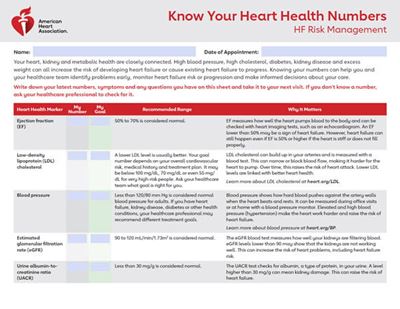
Use this worksheet to write down your latest numbers, symptoms and any questions you have for your healthcare team, and take it to your next visit:
Know Your Heart Health Numbers (PDF)