Let’s Talk About Cholesterol and Stroke
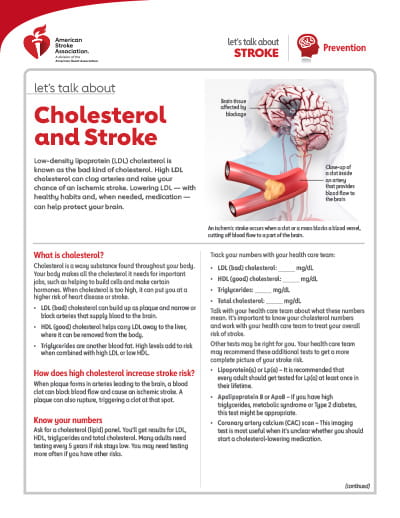 Low-density lipoprotein (LDL) cholesterol is known as the bad kind of cholesterol. High LDL cholesterol can clog arteries and raise your chance of an ischemic stroke. Lowering LDL — with healthy habits and, when needed, medication — can help protect your brain.
An ischemic stroke occurs when a clot or a mass blocks a blood vessel, cutting off blood flow to a part of the brain.
What is cholesterol?
Cholesterol is a waxy substance found throughout your body. Your body makes all the cholesterol it needs for important jobs, such as helping to build cells and make certain hormones. When cholesterol is too high, it can put you at a higher risk of heart disease or stroke.
- LDL (bad) cholesterol can build up as plaque and narrow or block arteries that supply blood to the brain.
- HDL (good) cholesterol helps carry LDL away to the liver, where it can be removed from the body.
- Triglycerides are another blood fat. High levels add to risk when combined with high LDL or low HDL.
How does high cholesterol increase stroke risk?
When plaque forms in arteries leading to the brain, a blood clot can block blood flow and cause an ischemic stroke. A plaque can also rupture, triggering a clot at that spot.
Know your numbers
Ask for a cholesterol (lipid) panel. You’ll get results for LDL, HDL, triglycerides and total cholesterol. Many adults need testing every 5 years if risk stays low. You may need testing more often if you have other risks.
Track your numbers with your healthcare team:
- LDL (bad) cholesterol: _____ mg/dL
- HDL (good) cholesterol: _____ mg/dL
- Triglycerides: _____ mg/dL
- Total cholesterol: _____ mg/dL
Talk with your healthcare team about what these numbers mean. It’s important to know your cholesterol numbers and work with your healthcare team to treat your overall risk of stroke.
Other tests may be right for you. Your healthcare team may recommend these additional tests to get a more complete picture of your stroke risk.
- Lipoprotein(a) or Lp(a) – It is recommended that every adult should get tested for Lp(a) at least once in their lifetime.
- Apolipoprotein B or ApoB – If you have high triglycerides, metabolic syndrome or Type 2 diabetes, this test might be appropriate.
- Coronary artery calcium (CAC) scan – This imaging test is most useful when it’s unclear whether you should start a cholesterol-lowering medication.
What can I do to lower my risk for (another) stroke?
Healthy habits
- Eat smart: Enjoy more vegetables, fruits, whole grains, beans, nuts and fish. Limit saturated and trans fats, sodium and added sugars.
- Move more: Regular activity on most days supports healthy cholesterol and blood pressure.
- Make healthy choices: Don’t smoke or vape. Avoid secondhand smoke. Limit alcohol.
- Manage your health: Keep your weight, sleep, blood sugar and blood pressure in a healthy range to support your brain and heart.
Medications (when needed)
- Statins are the most common medication used to reduce LDL and the risk of stroke.
- After a stroke or TIA from blocked arteries, many people need a statin.
- If your LDL stays at 70 mg/dL or above (or even 55 mg/dL or above for people at very high risk) on a statin, your healthcare team may add another medication. Your healthcare team will likely want to recheck your cholesterol 4–12 weeks after medication changes, then every 6–12 months.
- Don’t stop taking your medication without talking to your healthcare team first.
If you have high LDL or are a survivor of stroke, you are at higher risk for stroke. To help you remember the most common warning signs of a stroke, use B.E. F.A.S.T.:
B. = Balance Loss
E. = Eye (Vision) Changes
F. = Face Drooping
A. = Arm Weakness
S. = Speech Difficulty
T. = Time to Call 911
How can I learn more?
- Call 1-888-4-Stroke (1-888-478-7653) or visit stroke.org to learn more about stroke or find local support groups.
- Sign up for monthly Stroke Connection E-news for survivors of stroke and caregivers, at StrokeConnection.org.
- Connect with others who have also had an experience with stroke by joining our Support Network at stroke.org/SupportNetwork.
Do you have questions for your doctor or nurse?
Take a few minutes to write down your questions for the next time you see your healthcare professional. For example:
How can I reduce my risk of stroke?
We have many other fact sheets to help you make healthier choices, manage your condition or care for a loved one. Visit stroke.org/LetsTalkAboutStroke to learn more
© Copyright 2026 American Heart Association, Inc., a 501(c)(3) not-for-profit. All rights reserved. American Stroke Association is a registered trademark of the American Heart Association. Unauthorized use prohibited. WF-1449503 03/26